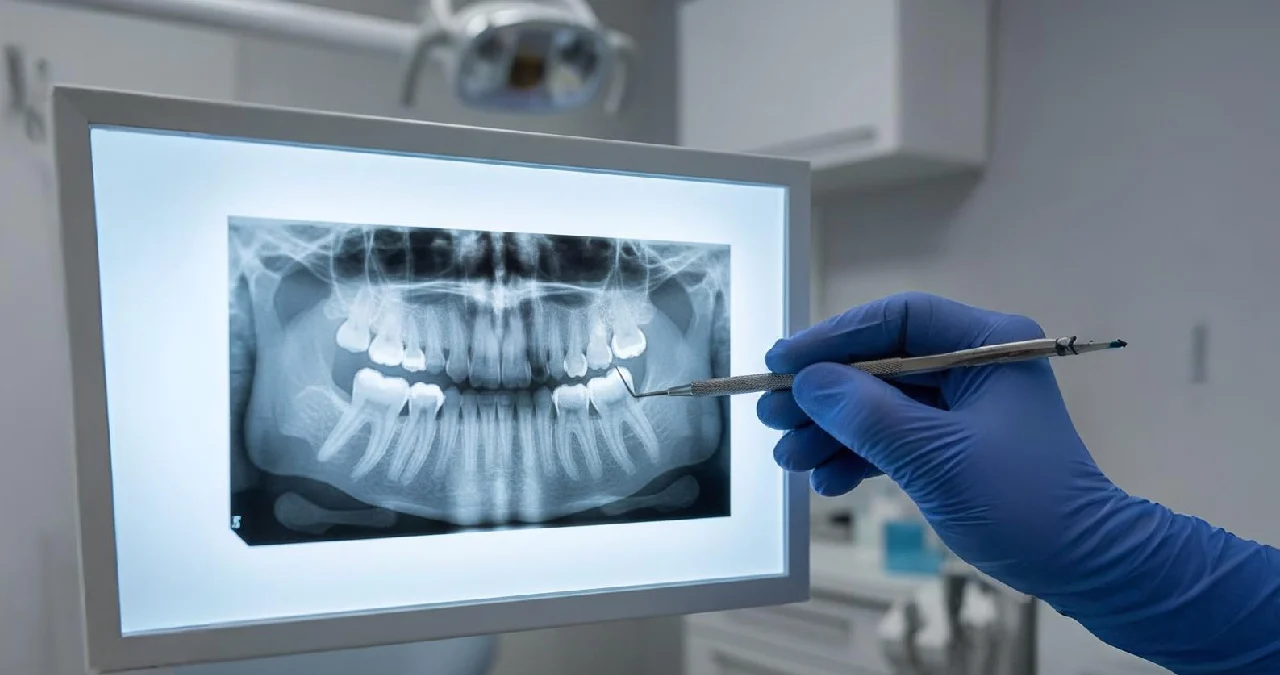
Ever had a root canal done, felt relieved, and then months later your tooth suddenly starts giving trouble again? That moment of panic is real — and the first question that hits is:
Can you see a failed root canal on X-ray?
Most people are surprised to learn that an X-ray can reveal many signs of root canal failure, but not always all of them. Think of an X-ray like a window: it shows what’s inside, but only from certain angles. Some problems are obvious, some stay hidden — at least at first.
In this guide, you’ll learn exactly how dentists use X-rays to detect root canal failure, what signs show up clearly, what doesn’t, and when additional scans are needed. Let’s break it down in the simplest, most relatable way possible.
What a Failed Root Canal Actually Means
A root canal is supposed to clean out infection, seal the tooth, and prevent bacteria from returning. But when something goes wrong, the treatment can fail — sometimes early, sometimes years later.
When the Cleaning Was Incomplete
Some teeth have long, twisted, or extra canals. If even a tiny area isn’t cleaned, bacteria remain trapped.
When the Infection Returns Later
Even if the original treatment was perfect, bacteria can re-enter through:
- a cracked tooth
- a loose crown
- a leaking filling
Why Early Detection Matters
The earlier you catch it, the more likely you can save the tooth — and avoid pain, swelling, or expensive surgery.
How Dental X-Rays Help Detect a Failed Root Canal
X-rays work by sending a small beam through the tooth and capturing an image of the roots and surrounding bone.
Radiolucency vs. Radiopacity
You’ll often hear dentists use these terms:
- Radiolucent (dark areas): may indicate infection, cysts, or bone loss
- Radiopaque (white areas): show healthy bone, root filling material, or dense structures
2D vs. 3D Imaging
- Standard X-ray: flat, 2D, great for general detection
- CBCT scan: 3D, shows every angle, catches hidden problems
Why Periapical X-Rays Are Critical
This specific type of X-ray focuses on the root tip — where most failures occur.
Can You See a Failed Root Canal on X-Ray?
The short answer: Yes, in most cases, you can see signs of a failed root canal on an X-ray — but not always.
Dentists look for patterns, shadows, and gaps that shouldn’t be there. But some failures are invisible until bone changes occur.
Let’s go deeper.
Clear X-Ray Indicators of a Failed Root Canal
Dentists are trained to look for specific clues. Here are the clearest signs:
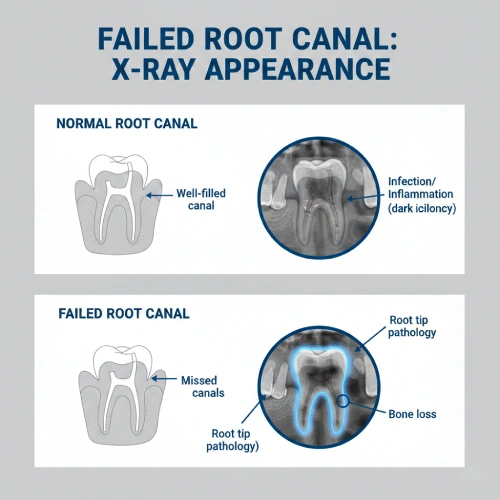
1. Dark Shadow at the Root Tip (Periapical Radiolucency)
This is the BIGGEST giveaway.
If you see a dark circle or halo around the root, it usually means:
- infection
- bone destruction
- an abscess
It’s like seeing a smoke ring — a sign something is burning inside.
2. Widened Periodontal Ligament Space
A slightly thickened line around the root often indicates inflammation.
3. Bone Loss Around the Root
Irregular or eroded bone structure = infection that’s been brewing.
4. Missed or Untreated Canals
Some teeth have 2–4 canals. If one was skipped, it appears empty on the X-ray.
5. Overfilling or Underfilling of Root Material
If the filling:
- doesn’t reach the root tip → bacteria may remain
- extends beyond the root → irritation or infection may occur
6. Signs of Root Fracture
Sometimes a narrow dark line may show up — hinting at a crack.
Symptoms That Support What the X-Ray Shows
X-rays alone aren’t enough. Your body sends warning signals too.
Persistent or Throbbing Pain
Pain when chewing or biting is often linked to infection under the root.
Swelling or a Gum Boil
A gum pimple that drains fluid = classic sign of abscess.
Tooth Discoloration
A darkening tooth can indicate ongoing infection inside.
Sensitivity to Hot or Cold
Even a root-treated tooth shouldn’t react strongly to extreme temperatures.
Why Some Failed Root Canals Don’t Show Up on X-Rays
Not everything appears immediately — some conditions are too small or too hidden.
Early Infection Is Invisible
Bone loss takes time. Early infections won’t show up until months later.
Complex Anatomy
Curved or overlapping roots can hide problems on a 2D X-ray.
Cracks May Not Appear
Hairline fractures are almost invisible on standard imaging.
When Dentists Use CBCT (3D Scans)
If symptoms persist but the X-ray looks “normal,” the dentist may order a CBCT scan.
CBCT Helps Detect:
- hidden infections
- missed canals
- tiny root fractures
- bone defects
- unusual anatomy
It’s like switching from a single photo to a full 3D movie.
How Dentists Confirm Root Canal Failure
Dentists combine multiple tools, not just X-rays.
Clinical Tests
- tapping the tooth
- pressure or bite tests
- temperature checks
- gum probing
Comparing Past X-Rays
If the dark area grows over time, infection is spreading.
Evaluating Healing
Sometimes radiolucency indicates healing. A dentist tracks size changes.
Main Reasons Root Canals Fail
Here are the top causes:
1. Missed Canals
Extra or hidden canals are a common reason for failure.
2. Leakage From Old Fillings
If the crown or filling isn’t airtight, bacteria slip back in.
3. Cracked Tooth
Cracks act like doorways for bacteria.
4. Incomplete Cleaning
Sometimes the canal anatomy is too complex.
5. Instrument Breakage
Rare but possible — part of a file remains inside.
Treatment Options After a Failed Root Canal
Good news: a failed root canal doesn’t automatically mean the tooth must be removed.
1. Retreatment
The most common solution:
- remove old filling
- clean canals again
- place new material
2. Apicoectomy (Root-End Surgery)
Used when the infection persists only at the root tip.
3. Extraction & Replacement
When the tooth is beyond saving:
- implants
- bridges
- partial dentures
What Patients Can Do to Protect Their Treated Tooth
Here’s how you can avoid recurrence:
Monitor Any New Symptoms
Pain, swelling, or sensitivity needs immediate attention.
Get Regular X-Rays
Follow-up X-rays every 6–12 months catch early issues.
Ensure Proper Crown Placement
A well-sealed crown protects against reinfection.
How to Prevent Root Canal Failure
Simple habits protect your treated tooth:
Good Oral Hygiene
Brush, floss, and use antibacterial mouthwash.
Avoid Hard Foods
Biting ice, nuts, or pens can crack roots.
Routine Dental Checkups
Prevention is always cheaper than treatment.
Conclusion
So, can you see a failed root canal on X-ray?
In most cases — yes, especially when there are clear signs like radiolucency, bone loss, gaps, or missed canals. But remember: not all problems are visible right away. Some infections and fractures hide until they grow larger or require 3D scanning.
If your tooth feels “off” or the pain keeps returning, don’t ignore it. Early diagnosis can save your tooth, prevent complications, and protect your long-term oral health.
FAQs
Can you see a failed root canal on X-ray if you have no symptoms?
Many failed root canals appear on X-ray long before pain starts.
How long after a root canal should an X-ray be taken?
Follow-up X-rays are usually done at 6 months and 12 months.
Can an X-ray miss a failed root canal?
Small infections, hidden canals, and fractures may require a CBCT scan for detection.
What does a failed root canal look like on an X-ray?
Usually a dark shadow (radiolucency) around the root tip.
Can a failed root canal be fixed without removing the tooth?
Yes. Retreatment or apicoectomy can save most teeth.